The 1975 No-S Roosevelt Dime: A Modern Rarity Hiding in Plain Sight
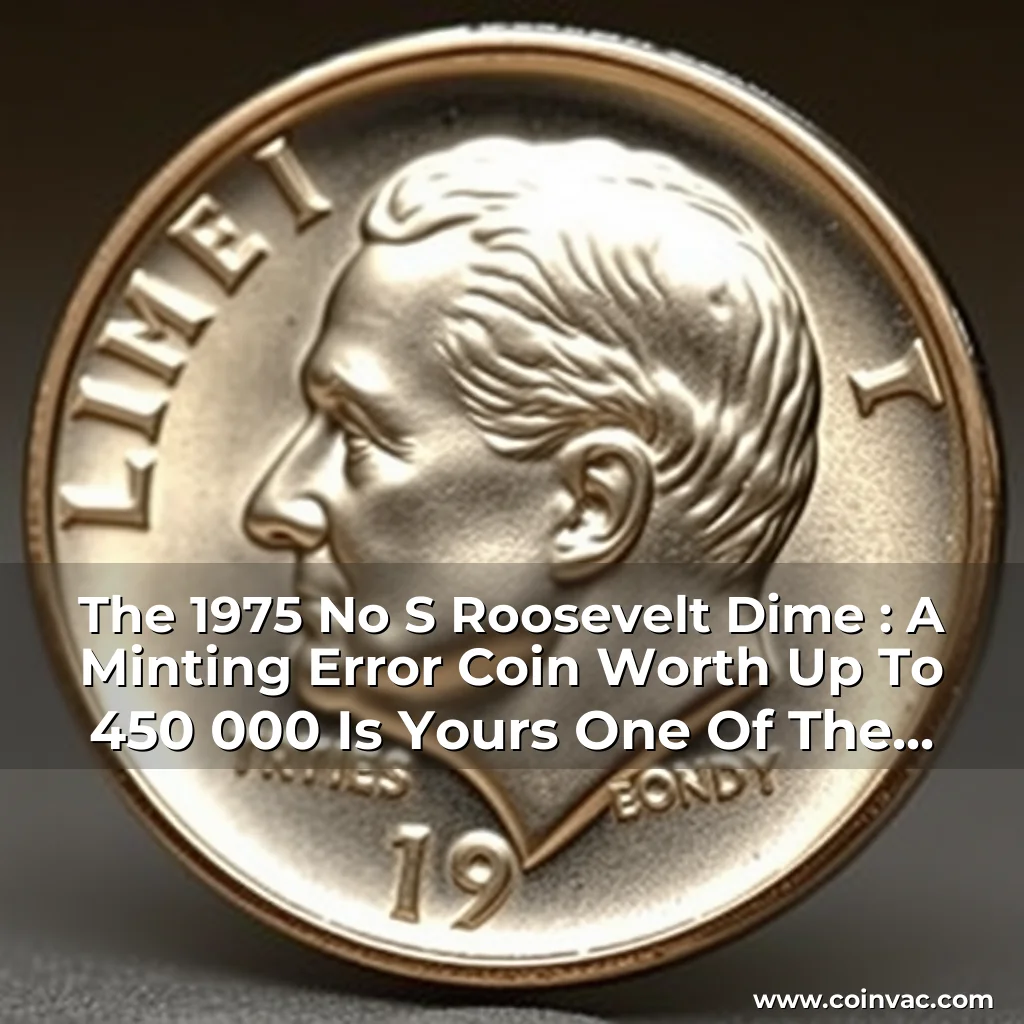
Most of the coins collectors chase for extreme rarity are old -- worn survivors of mintages struck decades or centuries ago. The 1975 No-S Roosevelt dime breaks that pattern entirely: a coin from a proof set sold to the general public within living memory, with only two authenticated examples known to exist, making it one of the most valuable and sought-after coins of the entire 20th century.
What a "proof" set is, and why an S mint mark should be there
Since the 1960s, the U.S. Mint has sold annual proof sets to collectors -- specially struck coins with mirror-like fields and frosted design elements, produced using a more careful process than ordinary circulating coinage, and specifically marketed to collectors rather than intended for circulation. Proof coinage for this era was struck at the San Francisco Mint, and coins from proof sets of this period were meant to carry an "S" mint mark identifying that origin, appearing on the obverse near the date.
The error: dies without a mint mark
A small number of 1975 proof dimes were struck using dies that had not yet had the "S" mint mark punched into them -- a step normally completed before a working die entered production. The resulting coins are proof-quality in every other respect -- sharp strike, mirrored fields -- but carry no mint mark at all where one should be. Only two examples are currently known to have survived and been authenticated, making this one of the rarest coins of the entire modern U.S. proof-set era, despite being less than half a century old at the time of its rediscovery.
Why so few exist
Proof sets are sold sealed, and most buyers never break them open to examine individual coins closely enough to spot something as subtle as a missing mint mark -- especially since a missing "S" doesn't change a coin's overall appearance dramatically at a glance. It's entirely plausible that additional examples remain undiscovered today, sitting unexamined in decades-old sealed proof sets in collections, safe deposit boxes, or estates where nobody has ever opened the packaging to check.
Why this coin matters beyond its price
The 1975 No-S dime is a useful reminder that extreme rarity isn't reserved for ancient or centuries-old coinage -- a modern coin, produced by the millions in an ordinary year, can carry an individual die variety so scarce that only a handful of examples are known, purely because of an overlooked step in a highly mechanized minting process. It's also a genuinely accessible story for new collectors: unlike an ancient coin requiring specialist attribution knowledge, checking a proof dime for its mint mark is something anyone can learn to do in minutes.
What this means for anyone with an old proof set
Given how few examples are confirmed and how plausible it is that more remain unexamined, any 1975 proof set is worth a careful look at the dime specifically -- checking for the presence or absence of the "S" mint mark near the date. Given the coin's documented rarity and value, anything that looks like a genuine candidate warrants professional authentication before any assumptions are made, exactly the same caution that applies to any claimed rarity discussed elsewhere on this site.
General historical information for collectors. Any coin believed to be a genuine example should be authenticated by a qualified third-party grading service before any valuation or sale.
How it compares to other modern rarities
The 1975 No-S dime sits alongside a small handful of other modern U.S. mint errors that prove scarcity isn't only a pre-20th-century story -- doubled-die cents, other missing-mint-mark proof coins from various years, and off-metal errors of the kind covered in a companion article on this site all show the same pattern: a mechanized, high-volume minting process occasionally produces a genuine one-in-a-million anomaly, and when collectors are paying close enough attention, that anomaly becomes a legitimate, documented rarity almost as soon as it's identified. What separates the No-S dime from most of these is simply the astonishingly small confirmed population -- most modern error varieties number in the dozens, hundreds, or more; this one is currently known in only two.
The lesson for anyone with unopened proof sets
Vintage sealed proof sets sitting in a drawer or safe deposit box are exactly where a discovery like this is most likely to still be waiting -- not because such coins are common, but because so few people ever take the time to examine every coin in every set they own closely enough to catch something this subtle. It costs nothing but a few minutes and a loupe to check, and the payoff, however unlikely in any single case, is about as large as modern numismatics gets.